

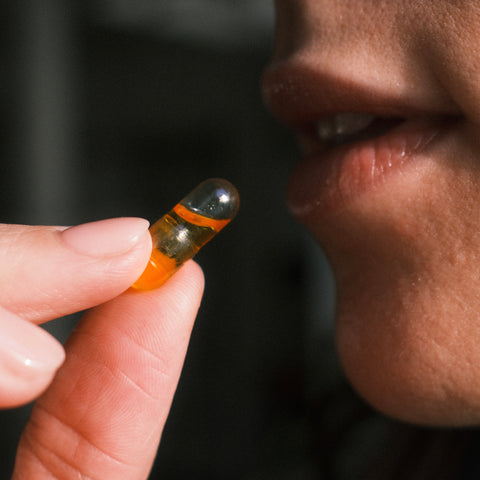


- There is no single best time of day for every probiotic. Morning and night can both work.
-
Whether to take a probiotic with food or on an empty stomach depends on the specific product and its strains.
-
Follow the instructions on your probiotic instead of relying on a general rule about timing.
-
For Tribiotic+, take one capsule daily with a meal, either in the morning or at night, preferably with healthy fats.
If you're taking a probiotic, you may have wondered whether you're getting the timing right. Should you take it before breakfast, with a meal, or at night before bed? The answer isn't the same for every probiotic.
The strains and formulation can affect how a probiotic should be taken, including whether food is recommended. For that reason, the product's instructions should come first. Once you know what your probiotic recommends, the simplest approach is to choose a time that fits naturally into your day and take it consistently.

Is It Better to Take Probiotics in the Morning or at Night?
There isn't strong evidence that probiotics generally work better in the morning than at night. Most research on probiotic timing has focused on when they are taken in relation to meals, rather than comparing morning and evening use directly.
So, if your probiotic allows either, choose the time that fits naturally into your day. Taking it around the same time each day can also make it easier to remember.
|
Morning |
Night |
|
Works well if breakfast is already part of your routine |
Works well if dinner or your evening routine is more predictable |
|
Convenient if you take other supplements in the morning |
Convenient if mornings tend to be rushed |
|
No clear evidence that morning is generally better |
No clear evidence that night is generally better |
The important point is not to turn probiotic timing into another thing to worry about. Follow the product's instructions, then choose a time you can maintain. The question of whether to take your probiotic with food or on an empty stomach is separate and depends more on the product and strains involved.
Should You Take Probiotics With Food or on an Empty Stomach?
This question is a little different because food can change what happens to a probiotic as it passes through the stomach.
Stomach acid and digestive enzymes can be hard on probiotic microorganisms. Eating changes the stomach environment, which may affect how many microorganisms survive the trip through the upper digestive tract.
A 2011 study published in Beneficial Microbes tested a four-microorganism probiotic in a laboratory model of the human upper gastrointestinal tract. The researchers found that the bacteria survived best when the probiotic was taken with a meal or 30 minutes before a meal. Survival was lower when it was taken 30 minutes after eating.
The type of meal also made a difference, with the probiotic surviving better with oatmeal and milk than with water or apple juice.
However, that doesn't mean every probiotic should be taken before or with a meal. The study tested a specific product and specific microorganisms. Different strains and formulations can behave differently, so advice for one probiotic shouldn't automatically be applied to another.
That's why you'll find conflicting instructions on probiotic labels. Some products recommend taking them with food, while others give different directions. Follow the instructions for the specific probiotic you're taking rather than assuming an empty stomach is always better.
Does It Matter What You Eat With Your Probiotic?
If your probiotic is meant to be taken with food, you generally don't need to plan a special meal around it. The main thing is to follow the instructions for the product you're taking.
Some probiotic products give specific recommendations about the type of meal to take them with. Those instructions can reflect how the particular strains and formulation were designed, so it's better to follow them than apply a rule from another probiotic.
For Tribiotic+, we recommend taking one capsule daily with a meal, preferably one that contains healthy fats. You can take it in the morning or at night, depending on which fits your routine better.
The healthy-fat recommendation is specific to Bioligent’s Tribiotic+. It shouldn't be turned into a general rule that every probiotic needs to be taken with fat.
You also don't need to build an elaborate supplement routine around your probiotic. Take it as directed and choose a meal that's already part of your day.
What If You Take Your Probiotic at Different Times Each Day?
Taking your probiotic at slightly different times from one day to the next isn't something to stress about. If the product allows morning or night, a few hours' difference doesn't mean you've automatically done anything wrong.
A regular routine can simply make it easier to remember. You might take your probiotic with breakfast most days, for example, or with dinner if that's when you're more likely to remember it.
If you miss your usual time, take it according to the product's instructions rather than trying to make up for the change by taking extra. If the label doesn't explain what to do after a missed dose, check with the manufacturer or a healthcare professional.
How to Fit Probiotics Into Your Routine
The easiest routine is usually the one that fits into something you already do every day.
-
Breakfast is already a habit? Take it with breakfast.
-
Dinner is more predictable? Take it with dinner.
-
The label says to take it with food? Pair it with a meal rather than taking it separately.
-
You often forget supplements? Keep your probiotic somewhere you will see it when you eat, or connect it to another daily habit.
If your schedule changes from day to day, don't worry about hitting the exact same time. Just return to your usual routine when you can. Follow the instructions on your specific product, especially if they include directions about meals or timing.
Find the Right Support for Your Biology
Your probiotic routine doesn't need to be complicated. Choose a time that works for your day, follow the product's directions, and keep it simple.
If you're looking for daily support for your gut and microbiome, Tribiotic+ combines prebiotic, probiotic, and postbiotic ingredients in one formula.
Not sure which Bioligent products fit what you're looking for? Take the 60-second quiz and find your starting point.